
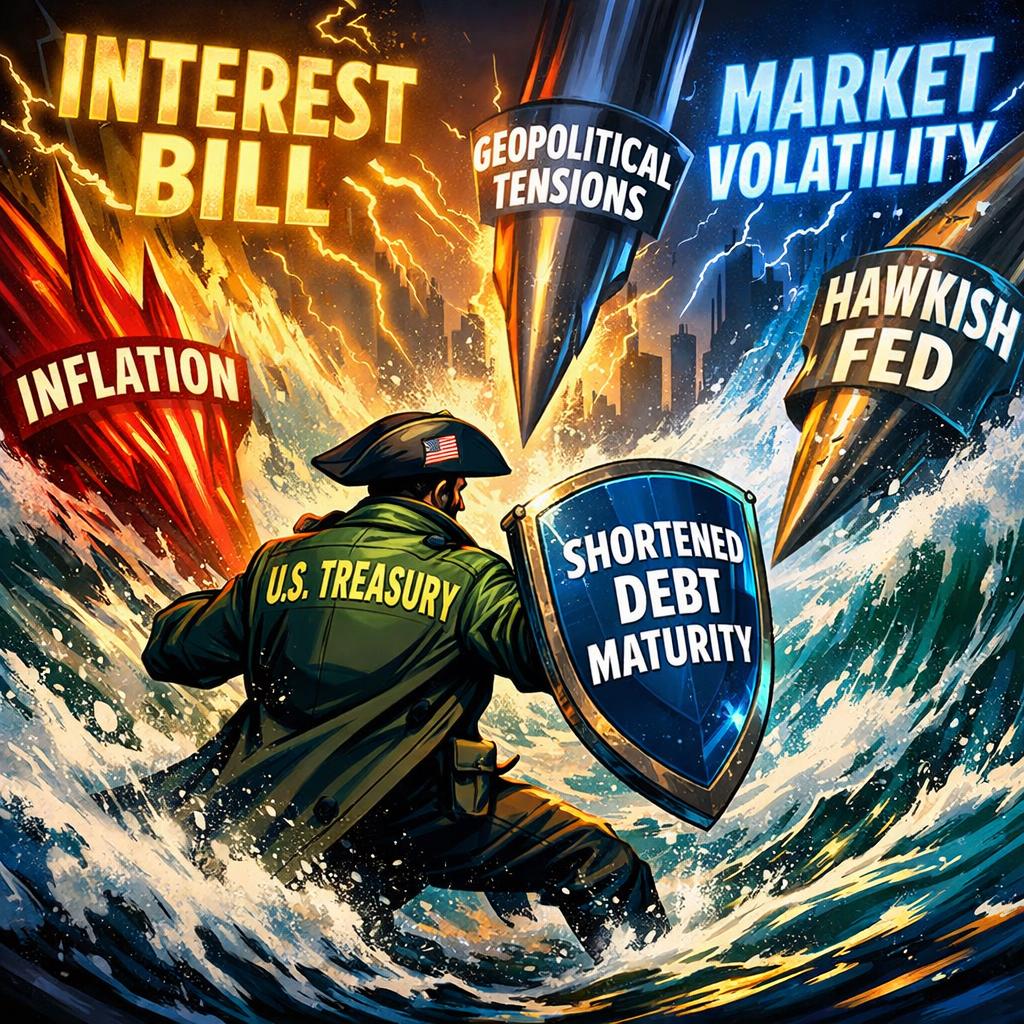
The intersection of global events and domestic policy often manifests in unexpected ways, directly influencing the daily lives of citizens. This week, a seemingly absurd statement from the US President regarding military intervention in bond markets, initially puzzling, reveals a deeper truth about the extraordinary measures being taken in the financial world. While the idea of deploying an army against a 10-year yield is nonsensical, it underscores the intensity of the struggle when all other conventional means have been exhausted. This situation connects disparate events—naval mines in the Strait of Hormuz, a 50% tariff on Canadian car parts, and the interest rate on your mortgage—as different perspectives on the same underlying financial reality.
The Treasury's Maverick Strategy: Challenging Market Yields
The current US Treasury Secretary, a lifelong macro manager with a history at Soros’s fund during the legendary bet against the British pound in '92, is now applying this trading philosophy to US national debt. His role, traditionally one of stewardship, has transformed into an active gamble against the entire bond market, using the nation's finances rather than personal capital. The central target of this strategy is the yield on the 10-year Treasury bond, which he deems "wrong." This yield is far from a technicality; it is the wholesale price of money, influencing everything from mortgage rates and car loans to corporate borrowing costs. Banks base mortgage rates on this yield, adding a premium for individual borrower risk.
On August 19, the Treasury made a surprise announcement, outside its regular schedule: a doubling of long-term bond repurchases. It is crucial to clarify that these repurchases are not "money printing," a power reserved for the Federal Reserve. Instead, the Treasury finances these buys by issuing shorter-term debt. The operation’s intent is to shorten the maturity of national debt, aiming to drive down long-term rates.
"Translated, it's a gamble that long-term rates will fall, financed by short-term borrowing."
If successful, the Treasury could refinance a substantial portion of debt at lower rates within a year. However, if rates rise, it faces the challenge of continuously rolling over a mountain of short-term debt at whatever rates the market demands. One JP Morgan analyst aptly described this maneuver as "paying the mortgage with a credit card."
The irony is not lost on observers. Before taking office, the current Secretary was a vocal critic of the previous administration's Treasury Secretary for precisely this strategy: skewing bond issuance towards short-term maturities to suppress long-term rates before elections, labeling it "activist Treasury management." This suggests that "activist debt management" is a severe market distortion only until one gains control of the Treasury.
The strategy faced a significant challenge not from the market initially, but from Stanley Druckenmiller, the Secretary's former mentor, whom he publicly lauded as "the greatest money generator in history." Druckenmiller, known for his editorial "Let the Bond Market Speak," systematically dismantled the operation. His argument is clear: there was no market breakdown, no failed auction, no forced selling as seen in March 2020. The market was functioning, simply producing a price the Treasury disliked.
"A rising long-term yield is the last thing left in Washington that forces politicians to deal with the deficit, because no one touches spending or taxes until the pain is visible. If you compress that yield, you turn off the alarm. Every basis point artificially lowered is a subsidy to procrastination."
Druckenmiller highlighted critical underlying facts: inflation persistently above target for years, a deficit nearing 6% of GDP (unprecedented in peacetime), national debt exceeding $40 trillion, and an annual interest bill surpassing the entire defense budget. He concluded:
"Governments that defend a price against fundamentals always lose. The only question is how much money they burn before admitting it."
Inflationary Pressures: Tariffs and Geopolitical Flashpoints
Adding to the Treasury's challenges, the administration is simultaneously implementing policies that exacerbate inflationary pressures. Recent trade negotiations with Canada collapsed, leading to the imposition of 50% tariffs on Canadian goods. A crucial detail often overlooked is that tariffs are taxes paid by American importers, not Canadian exporters, ultimately increasing the final price for US consumers. In the automotive industry, components can cross borders multiple times before a vehicle is complete. A tariff applied three times on a single component does not punish a rival; it makes an American-built car more expensive.
Inflation is the natural adversary of bondholders. If the market anticipates prices rising by 4% instead of 2%, it demands higher yields for lending money over 10 years. This creates a contradictory policy environment:
"With one hand, the Treasury buys bonds to crush yields. With the other, the administration fuels inflation that makes them rise. It’s the accelerator to the floor with the handbrake on."
A third, more tangible front involves oil prices, triggered by geopolitical tensions in the Strait of Hormuz. The US struck an Iranian island to counter what it described as a naval mine-laying operation. The method of mine deployment—launched by rockets from the coast, descending with parachutes, and detonating beneath hulls in the shallow strait—is particularly effective. The true impact, however, is not necessarily sinking ships. The mere act of being caught laying mines is enough. Shipowners, fearing risks to vessels, crews, and insurance premiums, will avoid the area.
"It’s not a naval weapon, it’s a psychological weapon and it works."
Consequently, transit through the Strait has dramatically reduced, pushing Brent crude prices towards $90 per barrel. Oil at $90 is inflation, and inflation means long-term yields that refuse to fall. This illustrates how a mine laid with a parachute can directly impact your mortgage rate. Furthermore, another contradiction exists: while one part of the government announces economic blockades against Iran, another has spent two years legally sanctioning financial infrastructure that Iran uses to circumvent these very blockades. These same structures are mandated to purchase short-term US government bonds—precisely the paper the Treasury is issuing to finance its repurchases. This "revolving door" blockade even allows for tolls to be collected by its architects.
The Fed's Unwavering Stance: A Head-on Collision?
All these pressures converge against the Federal Reserve's unwavering stance. At Jackson Hole, the Fed Chairman offered no relief. He reiterated that inflation has been above target for over 5 years, with the central bank's preferred measure hovering around 3.7%. He stated that current financial conditions could hardly be described as restrictive, concluding that "there is more work to do." The market immediately understood this as a signal for potential rate hikes. The probability of a hike at the September meeting surged from approximately 1/3 to about 60% in a single day.
A Looming Showdown: Treasury vs. Fed
The critical dynamic lies in the opposing bets of the Treasury and the Fed. The Treasury has shifted debt to shorter maturities, betting on falling rates, with roughly 1/3 of America's marketable debt due for renewal within 12 months. If the Fed raises rates, this wall of maturities will hit, and the interest bill on the entire debt stock will adjust upward—immediately.
The Treasury Secretary and the Fed Chairman are effectively betting on the same number from opposite sides. In the middle is a looming invoice with a due date.
Market Implications and Outlook
For equity markets, the immediate risk is not a collapse, but a significant "jolt." If a rate hike occurs, it's not necessarily indicative of recession or overheating, but rather a scenario where the central bank has no easy options. Historical precedents include 1997, which saw a 25 basis point hike after a series of cuts, leading to a sharp but brief correction. In 2018, a similar dynamic resulted in a -20% correction. Historically, in US mid-term election years, the market's peak often forms between August and September, though this is a frequency, not an obligation.
On the energy front, the Strait of Hormuz situation is unlikely to resolve quickly. Alternatives to the Strait—new pipelines, southern ports, or Mediterranean routes—have multi-year horizons, not weeks.
Regarding gold, there's a serious counter-argument that its value might be diminished in the current environment if the Fed's message is that it will not print money to solve problems, thus weakening gold's primary driver. However, the speaker’s position is that gold is held not against money printing, but against "arithmetic": $40 trillion in debt and an interest bill exceeding the defense budget cannot be resolved without some form of devaluation.
Bitcoin, while not the central player, currently holds steady at its 50-week moving average. A weekly close above this average would shift the outlook, while a close below would maintain the current perspective.
Ultimately, the core message remains: you cannot "invade a number." A yield is not a fortress or a port; it is the arithmetic of what you owe versus what the market is willing to lend.
"The most precious thing the US Treasury possesses is not money, it's the credibility built over 80 years of boring, punctual auctions."
A Secretary who declares war on market prices is spending this invaluable asset against an adversary with an infinite balance sheet and no deadlines. As Druckenmiller famously told his former protégé, if the 30-year yield needs to be 5.5% to attract buyers, "that's not a crisis, that's a bill."
The recommended investment strategy remains consistent: fractional and regular purchases, no leverage, no long-term bonds as primary investments, and maintaining liquidity as long as it yields. Three key indicators to monitor, in order of importance, are the next Federal Reserve meeting, the price of crude oil per barrel, and every single Treasury auction.