
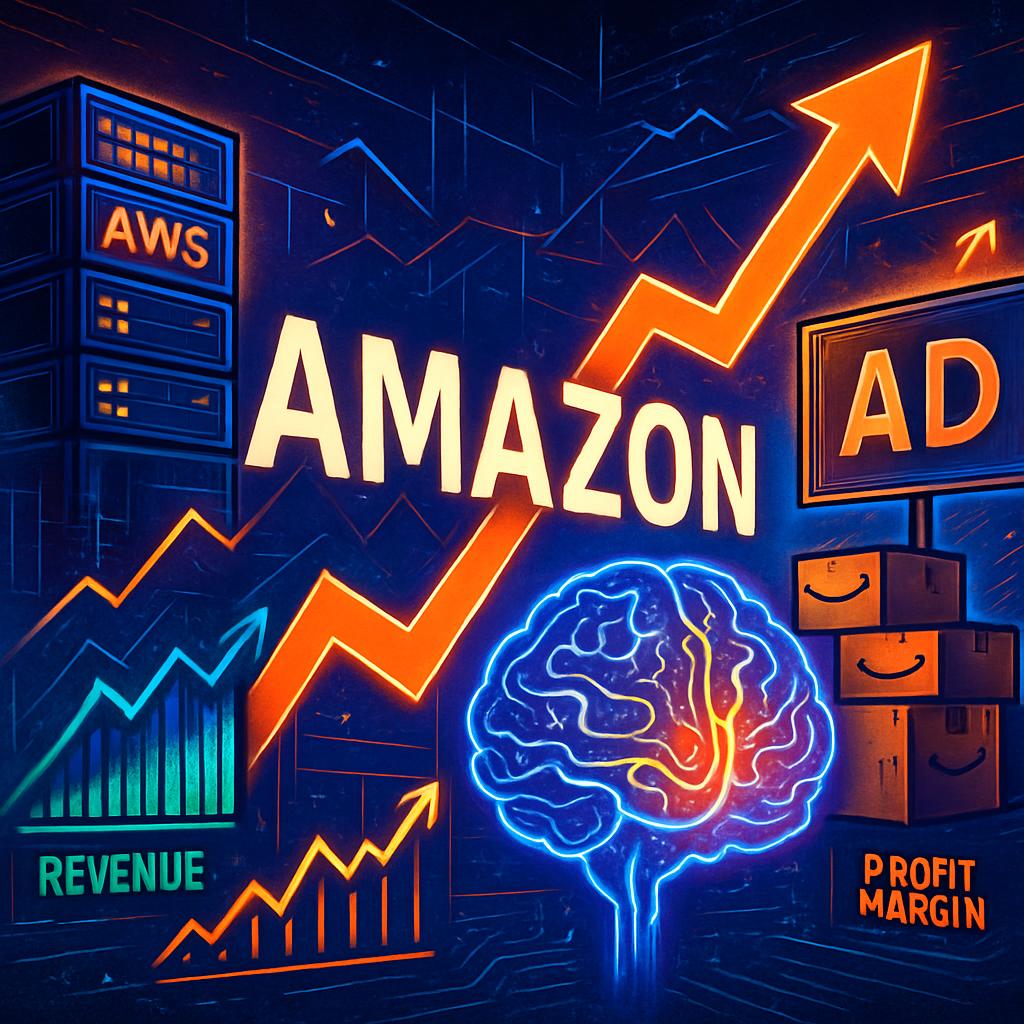
In the dynamic landscape of the stock market, identifying opportunities where fundamental business strength diverges from stock price performance is paramount. Currently, Amazon (AMZN) stands out as one of the most compelling setups, exhibiting a significant disconnect between its robust operational advancements and its lagging share price. This situation creates what can be described as a "rubber band effect," where a powerful catch-up is anticipated.
The investment methodology centers on identifying companies whose business metrics—such as margins and revenue growth—are consistently improving, while their stock price fails to reflect this progress. Amazon perfectly encapsulates this scenario, making it a prime candidate for substantial future appreciation.
The Disconnect: Price vs. Fundamentals
An initial glance at Amazon's stock performance over the past five years reveals an apparent underperformance.
While the S&P 500 has climbed 71% over this period, Amazon's stock has only increased by 58%, trailing the index by 13%.
This divergence, however, is merely half the story. The true picture emerges when examining Amazon's underlying business fundamentals during the same timeframe.
Robust Business Growth
A detailed analysis of Amazon's financials over the last five years paints a picture of exceptional growth and efficiency:
- Revenue: Has doubled, reaching $716 billion, and continues to grow at a double-digit rate of approximately 12% annually.
- Operating Margin: Also doubled, now standing at 11.6%.
- Free Cash Flow: Transformed from a negative -$14 billion to a positive +$7.7 billion.
- Assets: Tripled, accumulating to $820 billion.
- Net Income: Quadrupled, soaring to $77 billion.
Valuation Shift: Cheaper Despite Growth
Despite these impressive business improvements, Amazon's stock has become objectively cheaper. In 2020, the company traded at approximately 4 times sales; it now trades at 3.4 times sales. Similarly, its forward Price-to-Earnings (P/E) ratio has compressed from 56 in 2020 to 24 today. This indicates that the market has not yet fully priced in the significant fundamental enhancements.
The Amazon Transformation: Beyond Retail
Many investors still perceive Amazon primarily as an online retailer with an attached cloud service. This view is outdated. Amazon has profoundly transformed into a multi-faceted profit machine, driven by five core engines:
- Consumers: The traditional retail and subscription services.
- Sellers: The third-party marketplace, generating fees.
- Advertising: Leveraging its vast customer base for ad revenue.
- Cloud Infrastructure (AWS): Providing scalable computing power.
- Automation: Including logistics and operational efficiencies.
The old Amazon strategy focused on selling products, competitive pricing, swift delivery, customer satisfaction, and continuous reinvestment. While effective for 25 years, this model no longer fully applies. The "Amazon 2026" narrative involves strategically converting customer relationships into high-margin revenue streams through advertising, marketplace fees, and its burgeoning cloud business.
"A dollar of AWS revenue is worth far more than a dollar of first-party retail revenue... A dollar of an advertising revenue is actually worth far more than a dollar of first party retail revenue."
This shift towards higher-margin services means that as AWS, advertising, subscriptions, and third-party seller services continue to grow in importance—especially with the advent of AI—Amazon is poised to grow profits at a faster rate than revenue. The stock price, in turn, will be compelled to catch up.
AI as a Catalyst: The Anthropic Deal and Tranium Chips
The current AI mega-trend is a significant tailwind for Amazon, particularly for AWS. Unlike many AI narratives filled with buzzwords and vague promises, Amazon has concrete evidence of demand.
Concrete AI Demand: The Anthropic Commitment
The recent deal with Anthropic, a leading AI lab, is a testament to this demand. Anthropic has committed to spending over $100 billion over 10 years with Amazon, securing up to 5 gigawatts of compute capacity to train and run Claude, its large language model. Amazon's investment in Anthropic further solidifies this partnership, with $5 billion invested now, up to $20 billion more later, building on a prior $8 billion investment. This deal provides investors with a tangible, long-term demand signal, moving beyond speculative "pipe dreams" to actual dollars.
Vertical Integration with Tranium
Anthropic also gains access to Amazon's Tranium chips, a crucial development that positions Amazon as a vertically integrated cloud provider, akin to Google with its TPUs. This strategy is not about competing with Nvidia but about enhancing AWS's performance and economics. By running more training and inference on its own silicon, Amazon reduces supply chain dependence and lowers both operating and capital expenditure costs. This vertical integration grants Amazon greater control over costs, supply, pricing, and margins—a significant competitive advantage currently undervalued by the market.
The Power of Inference
While training frontier AI models captures headlines, inference—the recurring usage of AI models—is where the true explosion in demand lies. Every AI-powered tool, from coding assistants to customer service bots and enterprise agents, requires continuous compute. As AI becomes embedded in daily business operations, inference will transform into a recurring utility expense. Businesses prioritize not just the best model, but the most secure, reliable, integrated, and, critically, affordable solution at scale. This is precisely where AWS, powered by Tranium chips, is poised to excel.
A Snowball Effect of Profitability
The impact of these developments on AWS's profitability is substantial. AWS currently generates approximately $130 billion in annual revenue.
- If AWS grows at 15% annually for the next three years, its revenue could reach $200 billion.
- At 20% annual growth, it could hit $220 billion.
Given AWS's robust operating margin of about 35%, its operating income could surge from the current $45-50 billion range to between $69 billion and $85 billion over the next three years.
"At that point, AWS alone could be producing operating income close to what the entire company produced in recent years."
This projection doesn't rely on "fantasy assumptions" but on the continued, and arguably accelerating, enterprise adoption of AI. The Anthropic deal serves as concrete evidence that compute demand will continue to surprise to the upside, indicating that we are only in the early innings of this game.
Amazon's Evolution: From Store to Global Utility
Amazon's journey can be understood through three pivotal transformations:
- The Store Became the Mall: Initially a direct retailer, Amazon evolved into a marketplace, allowing third-party sellers to leverage its platform. This shifted its business model from pure retail to a platform economy.
- The Mall Became an Advertising Network: With millions of shoppers and sellers within its marketplace, Amazon naturally developed into a powerful advertising network, monetizing customer attention it already possessed.
- Internal Infrastructure Became a Global Utility: Amazon built its cloud tools (AWS) for internal use, then realized the broader market demand. AWS subsequently became the company's most significant profit engine. Now, AI is further amplifying the value of this infrastructure, as modern AI necessitates immense compute power and enterprise-grade deployment capabilities, which AWS uniquely provides. The Anthropic deal and Tranium chips perfectly align with this strategic playbook.
A Low-Risk, High-Reward Setup
Unlike many "hype growth stocks" that require numerous uncertain developments to justify their valuations, Amazon's investment thesis is refreshingly straightforward. There are no grand potentials to unlock or major uncertainties to navigate.
"Literally, the only thing that Amazon needs to do... All it has to do is keep on working. Just keep on doing what it's doing right now and the share price is going to go up because the fundamentals are going to make it happen."
For Amazon to deliver a 100-130% return over the next five years—a highly plausible scenario—two primary conditions must hold true:
- The AI mega-trend must be real: Amazon's growth is increasingly intertwined with the sustained demand for AI infrastructure.
- No macroeconomic collapse: A severe recession, widespread job losses, and a market crash would naturally impact all stocks, including Amazon.
Assuming these two conditions remain favorable—a reasonable assumption given current macroeconomic fundamentals and the undeniable trajectory of AI adoption—Amazon presents a compelling, low-risk, high-upside opportunity.
"Such a massive upside for a company that's already so established, it's criminal not to look at this and say, 'Hey, this is probably a really good addition to any portfolio in the stock market right now.'"
Amazon's established strength, combined with its strategic positioning in the highest-growth sectors of the economy, makes it an exceptionally attractive addition to any well-diversified investment portfolio.